Open Today Sales: 7:30 AM-7 PMOpen Today Service: 7:30 AM-7 PM

Comparing the 2026 Volkswagen Tiguan vs. Atlas is a great place to be on your car shopping journey. The compact, two-row VW Tiguan is more maneuverable, seats up to five, has 40.2 inches of legroom in both of its spacious rows, and can tow up to 1,800 pounds with available 4MOTION AWD (1,500 pounds with FWD).1 Meanwhile, the larger midsize, three-row Atlas SUV can seat six or seven, depending on the seating configuration, and tow up to 5,000 pounds,1 making it an excellent choice for growing families who need more space and strength. Compare their specs, dimensions, and appointments below with the Jim Ellis Volkswagen of Chamblee team.
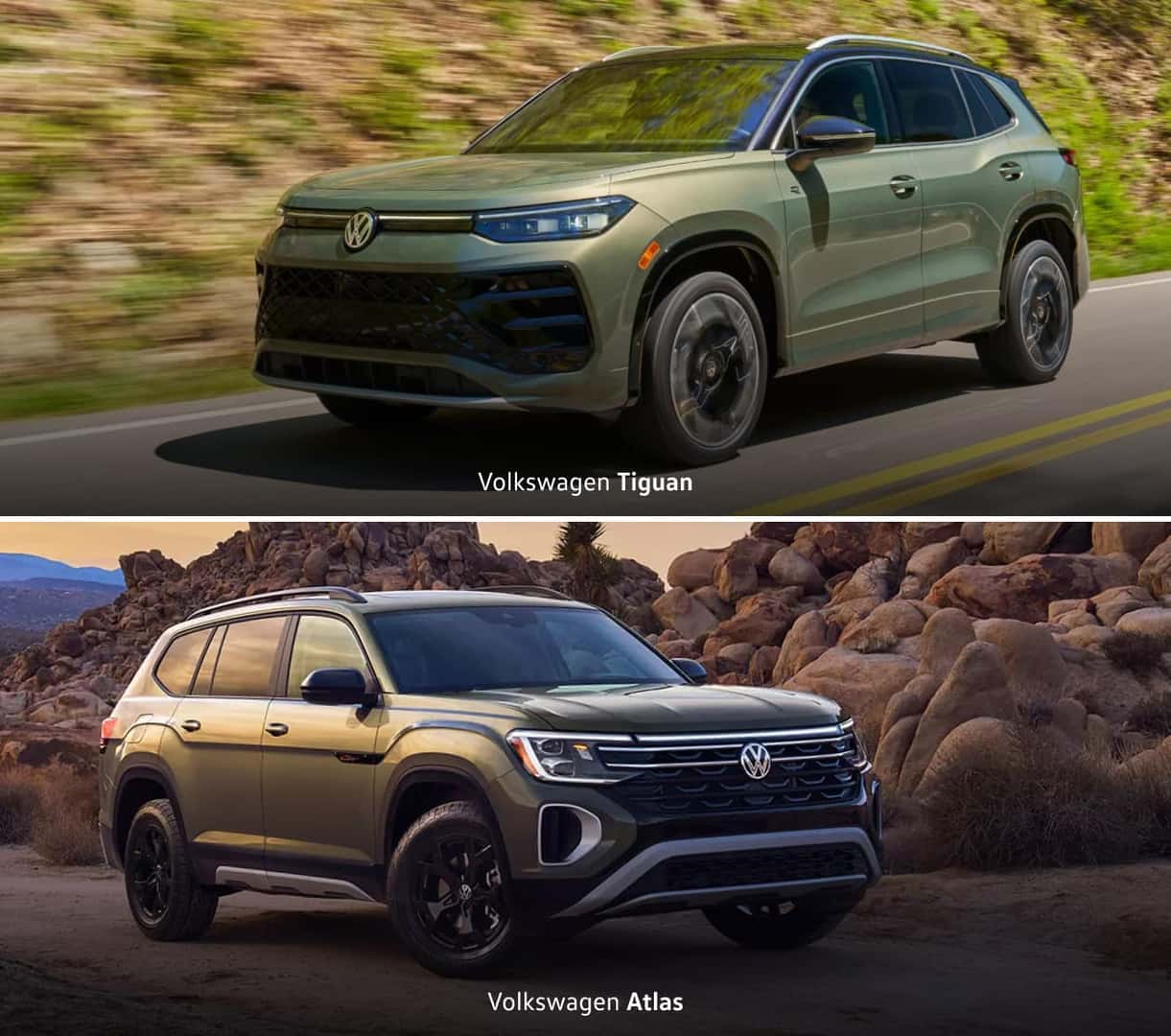
When comparing the Volkswagen Tiguan vs. Atlas, it’s important to remember that both are powerful and spacious SUVs. Neither is superior to the other – rather, they both offer varying strengths that will appeal to different drivers. The compact VW Tiguan is the smaller of the two and offers two rows of seating for up to five occupants. The midsize VW Atlas, on the other hand, has three roomy rows for six or seven people, depending on whether or not you opt for second-row captain’s chairs. The Jim Ellis Volkswagen of Chamblee team has put this page together to help you decide which model is the right option for your family. Let’s uncover the details.
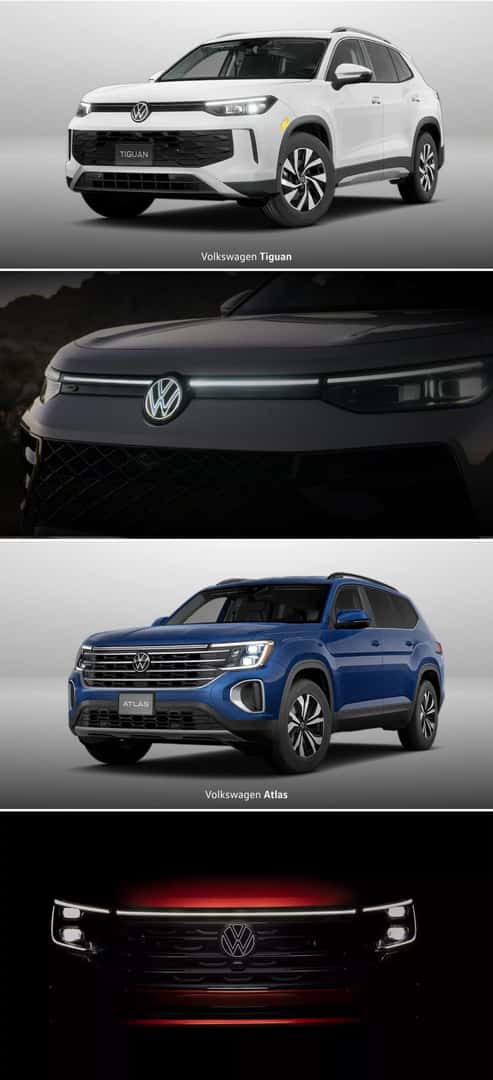
All 2026 Volkswagen Tiguan models come with an efficient 2.0-liter turbocharged four-cylinder powertrain, although you will find tuning and performance differences depending on the drivetrain and trim. The first three trims in the lineup – the S, SE, and SE R-Line Black – make 201 horsepower and 207 pound-feet of torque with front-wheel drive. Swap in available 4MOTION AWD with any of these iterations, and you’ll get a slight torque boost to 221 pound-feet.
The range-topping SEL R-Line Turbo edition gets an overall performance boost. Though it still uses a 2.0-liter turbo engine, you’ll be in command of 268 horsepower and 258 pound-feet of torque – this is nearly as potent as the Atlas SUV’s turbo powertrain. You also get standard 4MOTION AWD with the SEL R-Line Turbo.
If you choose all-wheel drive with any of the trims in the lineup, you’ll have access to additional Drive Modes. All models start off with Normal, Sport, and Eco, while AWD variants get the following available modes to improve the SUV’s performance in various driving conditions:
The VW Atlas also has a turbocharged 2.0-liter four-cylinder engine. However, in this midsize SUV’s case, it’s tuned to produce 269 horsepower and 273 pound-feet of torque no matter the drive type or model. Like the Tiguan, it features standard front-wheel drive and a smooth-shifting eight-speed automatic transmission – it can also be optioned with the automaker’s unique 4MOTION all-wheel drive to gain additional traction control and Drive Modes.
On paper, the VW Atlas doesn’t provide much additional output when compared to the top-tier Tiguan SEL R-Line Turbo, but there is a significant difference in towing potential for these two VW sport-utes. Every iteration of the 2026 Volkswagen Atlas can tow up to 5,000 pounds when properly equipped. You can use this powerful SUV to bring a small boat, a pair of ATVs, or a trailer along for your next trip. Meanwhile, towing strength for the VW Tiguan, like torque output, is influenced by the driveline. FWD models can tow up to 1,500 pounds,1 while AWD variants get a boost to 1,800 pounds.1 This is one primary difference between VW Atlas and VW Tiguan SUVs.
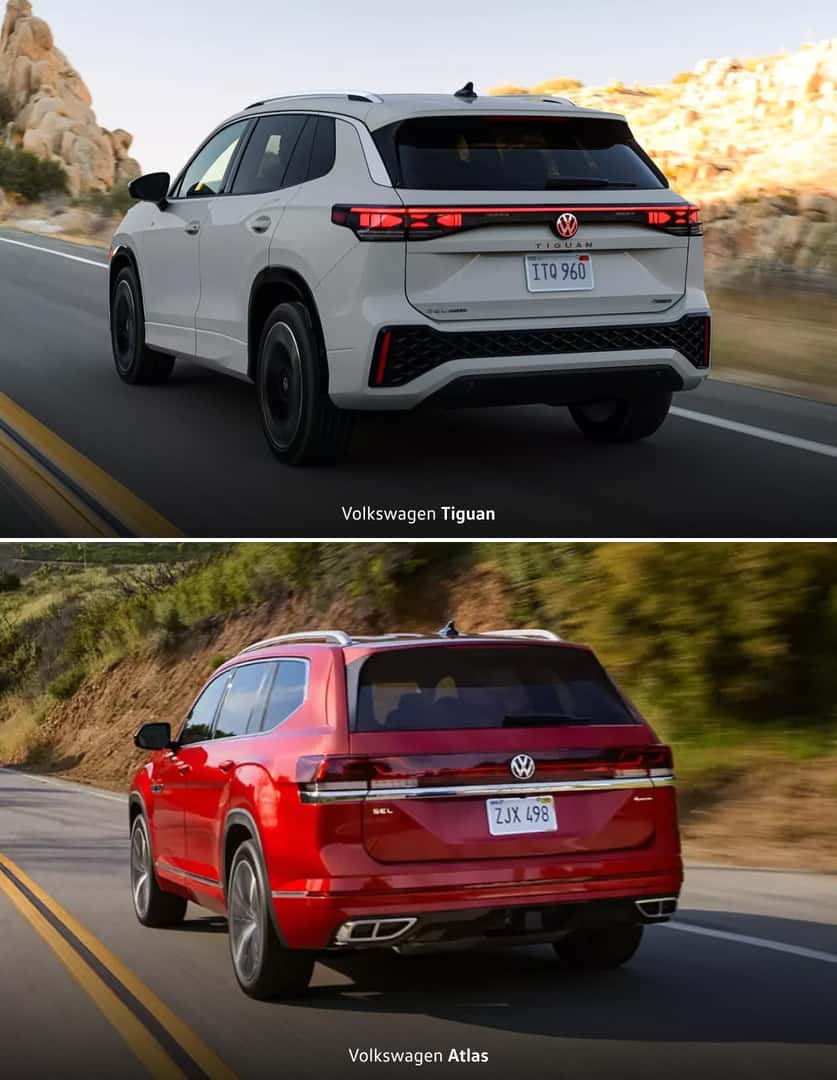
When comparing the VW Tiguan vs. Atlas, one finds that both vehicles get competitive fuel economy ratings. The 2026 Volkswagen Tiguan has four EPA ratings for its gas mileage specs – they vary by trim and drivetrain. The Tiguan MPG scores are as follows:
These ratings are quite competitive for the Tiguan SUV’s size. Unsurprisingly, since the Atlas is the larger vehicle, this part of our Tiguan vs. Atlas matchup slants toward the smaller SUV. The 2026 Atlas only has two MPG estimates from the EPA, and they come down to which drivetrain you choose:
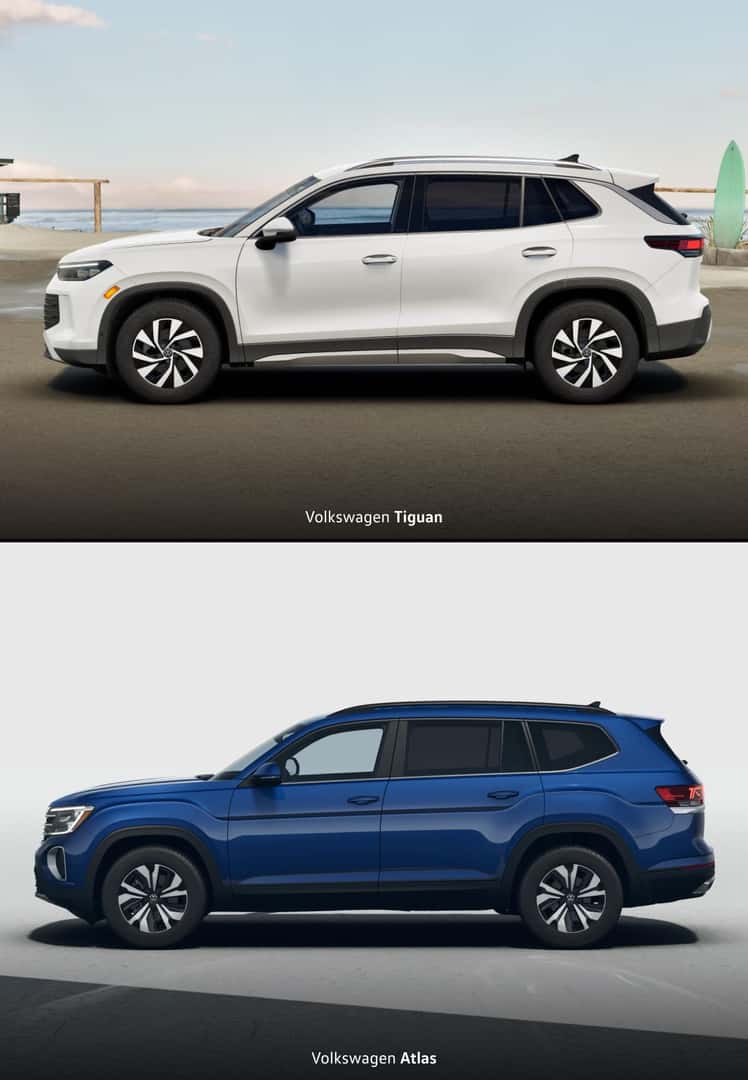
The new VW Tiguan rides on a 109.9-inch wheelbase and has the following exterior measurements:
The SEL R-Line Turbo has a slightly different profile than the other Tiguan iterations, coming in at 184.8 inches long, 73.5 inches wide (without mirrors), and 66.6 inches tall. As we shall see below, these measurements, no matter the Tiguan model, allow for a spacious interior despite the vehicle’s classification as a compact SUV.
The VW Atlas, which rides on a 117.3-inch wheelbase, has the following exterior measurements regardless of trim or drivetrain:
As expected, the midsize Atlas is larger than the compact Tiguan. It is up to 16.3 inches longer, 5.3 inches wider (excluding mirrors), and 4.3 inches taller, depending on the Tiguan configuration. The VW Atlas has more interior space as a result, but the Tiguan is more agile on the road and in parking decks. This part of the 2026 VW Tiguan vs. 2026 VW Atlas matchup is a toss-up – your needs will determine which size makes more sense for you.

The back row of the VW Atlas has two seats, just like the front, while the middle has either three or two – that means this SUV can seat six or seven occupants, depending on the trim and whether or not you opt for a VW Atlas with captain seats. Let’s take a look at its passenger measurements:
The Volkswagen Tiguan, on the other hand, tells a different story. This is where the main difference between the VW Atlas and VW Tiguan becomes apparent. The Tiguan offers just two spacious rows of seating, while the Atlas has three. Both have their benefits!
The Tiguan has spacious seating dimensions in both the front and rear rows, thanks to the removal of the third row when the SUV was redesigned in 2025. Its passenger space is as follows:
In terms of legroom, both the front and rear of the vehicle offer the space to stretch out, something that can’t be said for the Atlas SUV. This ample legroom makes the Tiguan vehicle’s second row more accommodating for tall back-seat riders.

We hope this discussion of the Volkswagen Atlas vs. Tiguan has helped you pick your next vehicle. Both provide distinct advantages and disadvantages: The Atlas is roomier overall and has more muscle, while the Tiguan gets better gas mileage and is easier to maneuver on the road. If you want to learn more, please visit us or check out our page on the new VW Tiguan Turbo.
No, the Volkswagen Tiguan does not have a third row. The new generation Tiguan debuted in 2025 with a host of updates, and the deletion of three-row configurations was one of them. Now a two-row SUV only, the Tiguan is able to focus on passenger comfort with as much rear legroom as there is in the front. Visit us to see it for yourself!
The Volkswagen Atlas uses a turbocharged 2.0-liter four-cylinder engine, but it does not require premium gasoline. This is quite a boon for drivers: They get to experience the efficiency and power of a turbocharger without paying extra at the pump. If you have any further questions about the Atlas engine, trims, or dimensions, please reach out to our friendly team today.
Both the Tiguan and the Atlas are exceptionally reliable VW SUVs. While the lifespan of a car will vary in accordance with how it is treated, these vehicles will generally be able to cross the 200,000-mile threshold with proper maintenance and attentive care. Please contact our knowledgeable dealership team today if you would like to discuss these vehicles’ reliability.
1Maximum tow rating when equipped with 2.0-liter turbo four-cylinder engine and factory-installed towing hitch. Vehicle load, other accessories, and options may reduce maximum towing capacity. See vehicle Owner’s Manual for details.
226 city/34 highway mpg (2026 VW Tiguan S FWD 2.0-liter turbo four-cylinder, eight-speed automatic transmission). EPA estimates. Your mileage will vary and depends on several factors, including your driving habits and vehicle condition.
325 city/32 highway mpg (2026 VW Tiguan SE, SE R-Line Black FWD 2.0-liter turbo four-cylinder, eight-speed automatic transmission). EPA estimates. Your mileage will vary and depends on several factors, including your driving habits and vehicle condition.
422 city/30 highway mpg (2026 VW Tiguan S, SE, SE R-Line Black AWD 2.0-liter turbo four-cylinder, eight-speed automatic transmission). EPA estimates. Your mileage will vary and depends on several factors, including your driving habits and vehicle condition.
522 city/29 highway mpg (2026 VW Tiguan SEL R-Line Turbo 2.0-liter turbo four-cylinder, eight-speed automatic transmission). EPA estimates. Your mileage will vary and depends on several factors, including your driving habits and vehicle condition.
620 city/27 highway mpg (2026 VW Atlas FWD 2.0-liter turbo four-cylinder, eight-speed automatic transmission). EPA estimates. Your mileage will vary and depends on several factors, including your driving habits and vehicle condition.
720 city/26 highway mpg (2026 VW Atlas AWD 2.0-liter turbo four-cylinder, eight-speed automatic transmission). EPA estimates. Your mileage will vary and depends on several factors, including your driving habits and vehicle condition.